So you’ve finally decided to order bulk t-shirts for your company, event, or team. Great move. But now comes the question that makes even experienced procurement managers pause for a second — which printing method should I choose?
Screen printing, DTF, embroidery. Three words. Three very different results. And a lot of confusion in between.
Let’s fix that right now — clearly, honestly, and without the jargon.
Table of Contents
ToggleWhat Are These Three Methods, Actually?
Before jumping into comparisons, let’s quickly understand what each method does.
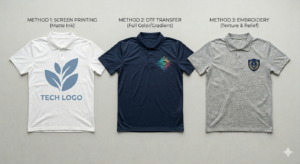
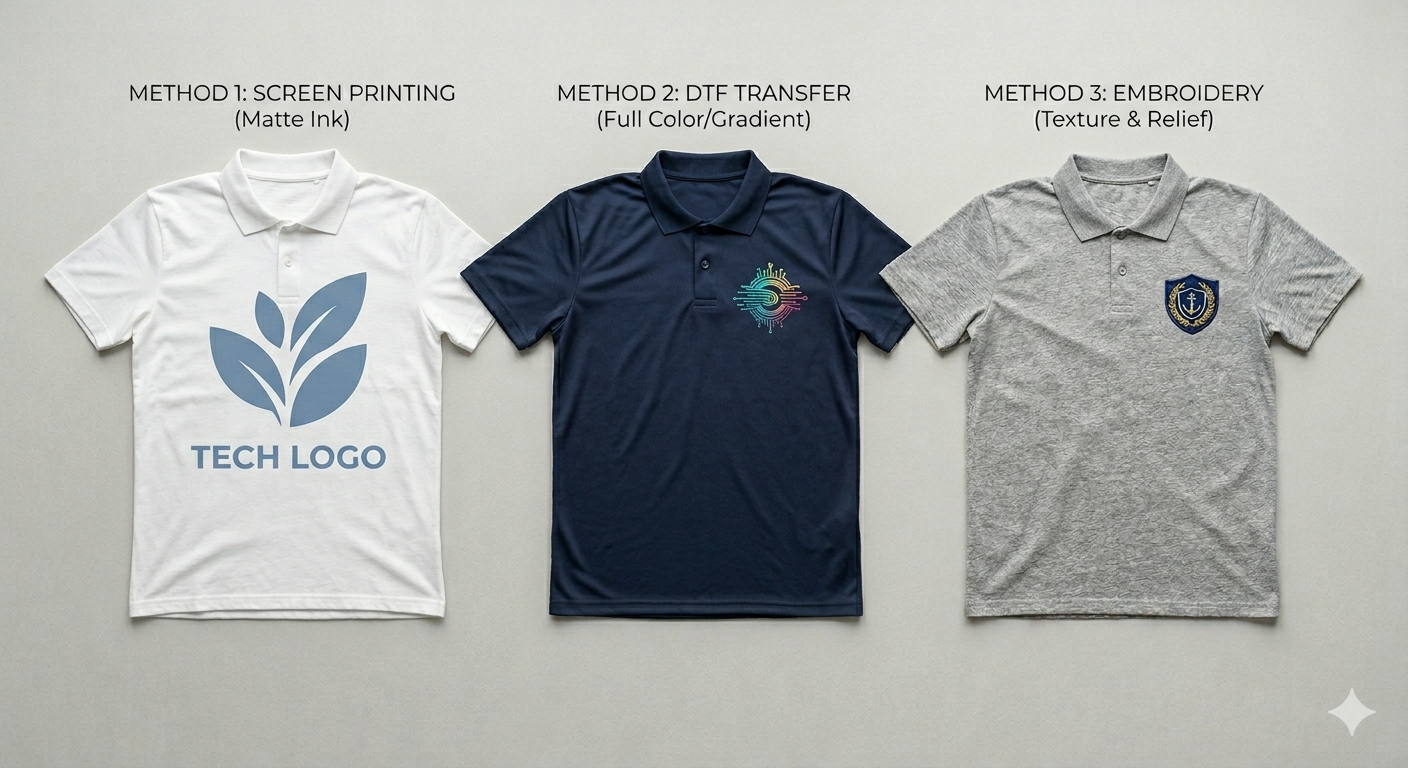
Screen printing works by pushing ink through a mesh screen onto your fabric — one colour at a time. It’s been the backbone of the custom apparel industry for decades and remains the most widely used method for bulk orders globally.
DTF (Direct-to-Film) printing is the newer kid on the block. It prints your design onto a special film, coats it with adhesive powder, and then heat-presses it onto the fabric. No screens. No colour limits. No minimum order required. DTF has become extremely popular in 2024–2025 because customers want faster sampling, unlimited colours, and freedom to print complex logos.
Embroidery is a completely different beast. Instead of printing, a machine stitches your design directly into the fabric using thread. The result is a premium, textured finish that conveys professionalism and quality. Think corporate polo shirts, not event giveaway tees.
The Real Difference: Cost Per Piece
Here’s where most buyers make their biggest mistake — they compare the wrong numbers.
Screen printing is by far the cheapest for bulk orders of 50+ pieces with simple 1–4 colour designs. At 100+ shirts, screen printing can cost as little as $3–5 per print location.
But here’s the catch. Setup costs per colour can quickly eat into profits on small runs, making screen printing less attractive when your order is under 50 pieces.
DTF, on the other hand, keeps costs consistent. You pay roughly the same amount per piece whether you’re printing 1 shirt or 50. That makes it genuinely attractive for smaller batches or trial runs.
Embroidery plays by entirely different rules. Embroidery pricing is based on stitch count, not quantity — small logos remain affordable even at lower quantities. A small chest logo on a polo shirt typically costs more per piece than screen printing, but the longevity often justifies the investment.
Bottom line on cost: For large uniform orders (100+ pieces) with simple designs, screen printing wins on price. For small runs or complex artwork, DTF is smarter. For premium branding on polos and jackets, embroidery adds value that printing simply cannot replicate.
Design Complexity: Who Handles It Better?
Not all logos are created equal. Some are clean two-colour wordmarks. Others are detailed illustrations with gradients, shadows, and fine lines.
DTF is your go-to for intricate, full-colour images. Since it’s a digital process, you can print multi-colour designs, fine gradients, and detailed prints without worrying about screens or colour limitations.
Screen printing, though vibrant, has a hard limit. Each colour in your design gets its own screen, and ink is pushed through layer by layer. More colours = more screens = more cost. For photographic or gradient-heavy designs, screen printing simply isn’t practical.
Embroidery is the most limited in terms of design complexity. These machines can’t easily replicate fine details or complex colour gradients. If your logo has thin lines, very small text, or a realistic photograph — embroidery will struggle with it.
A good rule of thumb: if your design has fewer than 5 colours and bold shapes, screen printing nails it. If it’s colourful and detailed, go DTF. If it’s a clean brand logo on a polo or jacket, choose embroidery.
Durability: Which Method Actually Lasts?
You don’t want your t-shirts looking tired after 10 washes. Neither do your employees or event attendees.
Screen printing generally lasts longer on cotton and cotton-blend fabrics. The chemical bond between plastisol ink and cotton fibres is strong and flexible enough to survive 50 or more wash cycles without significant fading or cracking.
DTF holds its own too. On synthetic fabrics like polyester, performance blends, and moisture-wicking athletic wear, DTF offers comparable or superior durability — often lasting 50 to 60 washes with less cracking than screen printing.
Embroidery, however, is in a league of its own when it comes to longevity. The thread is literally part of the fabric and will never fade or crack. That’s not marketing language. That’s just physics. Thread stitched into fabric doesn’t peel, crack, or fade the way ink on a surface eventually does.
One important note: always ask your print shop what ink system and cure temperature they use. A properly cured screen print or DTF transfer makes the difference between a shirt that lasts two years and one that starts peeling after a month.
Which Fabric Works Best With Each Method?
This is something many buyers completely overlook — and then regret.
DTF works on cotton, polyester, blends, leather, and even textured fabrics. It’s the most versatile option and rarely requires pre-treatment.
Screen printing works beautifully on cotton and cotton blends but has limitations on synthetics. On synthetic fabrics, you often need special inks and additives to prevent colour bleeding (dye migration), which adds complexity and cost to your order.
Embroidery suits thicker, more structured fabrics — polo shirts, jackets, and caps, where the thicker material can support the stitched design without distortion.
If your bulk order is for lightweight event t-shirts, screen printing or DTF works perfectly. If it’s for polo shirts, hoodies, or corporate jackets — embroidery is the premium choice.
Turnaround Time for Bulk Orders
Speed matters — especially when you’re racing against an event date or a new employee joining Monday morning.
Standard turnaround for all methods is typically 10–14 business days from artwork approval. Screen printing setup takes longer for first orders due to screen creation, but reorders are faster. DTF is the quickest for small orders — no screens needed. Embroidery requires digitising for first orders but saves your logo file for all future repeat orders.
In practical terms: DTF is the fastest to get started. Screen printing is fastest at scale once setup is done. Embroidery takes the most time for the first order but gets quicker on repeat orders.
Corporate Use Case: What Do Companies in India Actually Choose?
For corporate t-shirt orders in India, the choice usually depends on three things — the garment type, the brand positioning, and the budget.
For a premium, long-lasting look, embroidery on corporate polo shirts is the preferred choice. For budget-conscious large orders, printing is more affordable and handles detailed, colourful logos better.
Many Indian companies use a smart combination: embroidery for polos and hats, and screen printing for t-shirts and hoodies. That’s genuinely the smartest approach — you get premium-feel garments for client-facing staff and cost-effective printing for internal teams or events.
Quick Comparison: Screen Printing vs DTF vs Embroidery
| Factor | Screen Printing | DTF | Embroidery |
|---|---|---|---|
| Best for | Bulk orders, simple designs | Small runs, complex artwork | Premium uniforms, logos |
| Cost at scale | Very low | Moderate | Higher per piece |
| Design complexity | Limited colours | Unlimited | Simple/bold only |
| Durability | 50+ washes | 50–60 washes | Lifetime |
| Fabric range | Cotton best | Works on almost anything | Thicker fabrics best |
| Turnaround | Slower first order | Fastest | Slower first order |
| Feel | Flat, smooth | Slightly textured | Raised, premium |
So, Which One Should You Actually Choose?
There’s no single winner here — and anyone who tells you otherwise is trying to sell you something specific.
There is no universal winner. There is only the right fit for your business. For professional, durable, high-end branding — choose embroidery. For bold, cost-effective, high-volume marketing — choose screen printing. The best overall strategy for many companies is to use both.
Here’s the simplest decision framework:
- Ordering 100+ t-shirts with a simple logo for an event or team? → Screen printing, no question.
- Need 20 t-shirts with a full-colour, detailed design? → DTF is your answer.
- Ordering polo shirts or jackets for client-facing employees? → Embroidery gives you the premium edge.
- Tight deadline, small run, complex design? → DTF gets it done fastest.
Final Word from Bulk T-Shirts Adda
At Bulk T-Shirts Adda, we work with all three methods daily. Our recommendation always starts with one question: what will this garment be used for?
The branding method you choose directly affects how your team looks, how long the garments last, and how much you spend over time. Get that decision right from the start — and the rest becomes easy.
Have a bulk order in mind? Talk to our team in Delhi and we’ll help you pick the right method, fabric, and design approach for your exact requirement.