Table of Contents
ToggleWhy Fabric Is the First Decision You Should Make
You’ve finalised your corporate t-shirt design. The logo looks great. The colour is on-brand. But here’s the thing — if you choose the wrong fabric, none of that matters. Employees will wear an uncomfortable shirt once, and after that it lives permanently at the back of their wardrobe.
Fabric is not a background decision. It is the decision. Everything else — printing method, GSM, fit — builds on top of it.
This guide breaks down exactly what you need to know when ordering corporate t-shirts in bulk. Whether you need corporate polo t-shirts for your front desk team or round-neck promotional t-shirts for your next brand event, this will save you from expensive mistakes.
The Three Main Fabric Types — and What They Actually Mean for Your Business
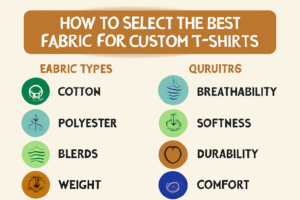
1. 100% Cotton
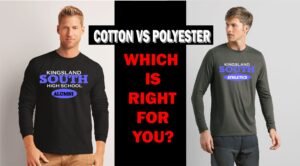
Cotton is the most popular fabric choice for corporate t-shirts, and it has earned that position honestly. It is breathable, soft against the skin, and holds print colours exceptionally well — especially for screen printing and DTG (direct-to-garment) printing.
Cotton is the go-to fabric for most people because it is soft and non-irritant. Cotton tees are popular with everyone, so it’s a safe bet.
The downside? Cotton may shrink a bit, can stain, wrinkle, and tends to absorb moisture and hold it rather than allow it to evaporate quickly.
For Indian businesses — especially in cities like Delhi, Mumbai, and Ahmedabad where summers are intense — 100% cotton can feel heavy and damp after a few hours. It works well for indoor office wear or air-conditioned environments, but it’s not ideal for field staff or outdoor events.
Best for: Office staff, indoor environments, branded gifting, promotional giveaways.
2. 100% Polyester
Polyester is the go-to fabric when durability and moisture management matter more than that “natural” feel. 100% polyester keeps its shape, so there is almost zero shrinking or stretching, regardless of what kind of wash and dry cycle you put it through.
Polyester is lightweight, breathable in terms of moisture-wicking, and can withstand wear and tear. But unlike cotton, polyester doesn’t feel as soft on the skin.
For corporate polo t-shirt designs meant for logistics teams, delivery staff, or outdoor-facing roles, polyester performs considerably better than cotton in India’s climate.
One thing to keep in mind: polyester has limitations with certain printing methods. One common problem is dye migration, which occurs when the dyes in the polyester fibres migrate into the ink, causing the design to appear blurry or discoloured. Always check with your corporate t-shirt manufacturer before finalising your printing method.
Best for: Field teams, outdoor events, delivery staff, sports uniforms, performance-focused workwear.
3. Cotton-Polyester Blends — The Smart Middle Ground
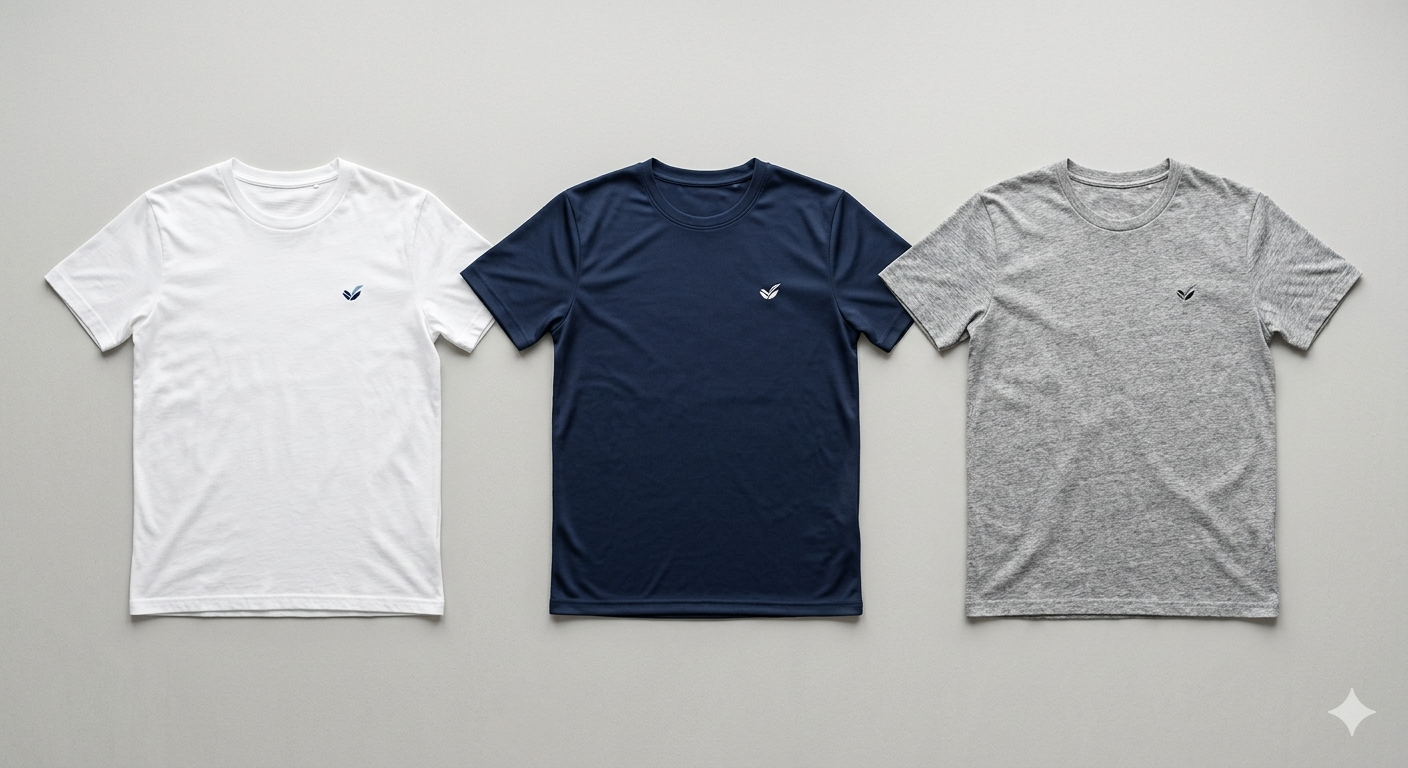
If cotton and polyester had a business partnership, the blend would be their best product. A 50/50 cotton-polyester blend combines the softness of cotton with the durability of polyester. These blends are popular for promotional t-shirts and uniforms, offering comfort and performance.
Cotton-polyester blends or polos with a bit more structure are durable, comfortable, and look professional even after repeated washes.
For most corporate t-shirt bulk orders in India, a blend is the most practical and cost-effective choice. It handles repeated washing without losing shape, and it takes screen printing well. Corporate t-shirt manufacturers across Delhi and Ahmedabad commonly recommend a 60/40 cotton-polyester mix for uniform orders.
There is also a premium option worth knowing about: CVC (Chief Value Cotton) blends. CVC describes a blend of cotton and polyester that contains more cotton than polyester, with the most common blend being 60% cotton and 40% polyester. CVC fabrics offer a softer, more cotton-like feel compared to 50/50 blends while still retaining some of the durability and moisture-wicking properties of polyester.
Best for: Corporate uniforms, bulk promotional orders, polo t-shirts, everyday employee workwear.
What Is GSM — and Why You Cannot Ignore It
GSM stands for grams per square meter. It measures how heavy or dense a fabric is. A higher GSM usually means a thicker, heavier fabric, which can affect the shirt’s durability and feel.
Here’s a quick reference for corporate t-shirt orders:
- 120–160 GSM — Lightweight. Good for summer events and giveaways.
- 170–220 GSM — Medium weight. Ideal for corporate uniforms and polo shirts.
- 220–260 GSM — Heavier. Suited for premium branded merchandise and winter months.
For uniforms, a 220 GSM poly-cotton blend often outperforms a heavier cotton fabric when it comes to durability and ease of maintenance.
For quality t-shirts in India, 160–180 GSM cotton jersey is the sweet spot — substantial feel without being heavy.
An important thing to remember: GSM alone doesn’t guarantee quality. A 280 GSM cotton fleece may feel thick but pill quickly after a few washes, while a 200 GSM polyester interlock can last much longer. Always ask your manufacturer about the yarn quality and knit construction alongside the GSM.
Corporate Polo T-Shirts: A Special Mention
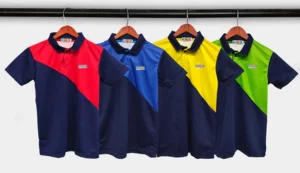
Corporate polo t-shirts are a staple for sales teams, hospitality staff, and client-facing employees. The collar adds a level of professionalism that a round-neck simply doesn’t. But polo t-shirts come with their own fabric considerations.
Pique cotton polo t-shirts are often available in weights like 180 GSM or 200 GSM, which indicate medium to heavy fabric suitable for year-round wear.
For corporate polo t-shirt uniform orders, a cotton-polyester blend at around 200 GSM balances durability with easy maintenance. This is the combination that most corporate t-shirt manufacturers in Delhi and Ahmedabad recommend for client-facing team uniforms.
For corporate polo t-shirt design ideas, pique fabric gives you the texture that makes embroidery look sharp and structured. If your branding uses embroidery rather than print, always go with a pique polo — the raised texture holds stitching far better than plain jersey.
Fabric and Printing: They Have to Work Together
This is one area where businesses regularly trip up. They pick a fabric they love, then find out their printing method doesn’t work well with it.
Here is a straightforward breakdown:
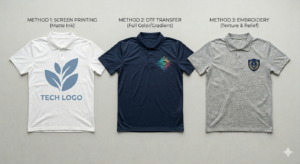
Screen printing works best on cotton-rich fabrics. The natural fibres give ink a strong surface to bond with, which means your corporate t-shirt design stays vivid through many washes.
DTG (Direct to Garment) printing produces the sharpest results on 100% cotton. Cotton t-shirts are best printed on using direct-to-garment printing because their surface can easily take on crisp and vibrant prints.
Embroidery needs structure. Polyester’s rigid fibre structure makes it an ideal substrate for raised 3D embroidery, as it prevents the fabric from puckering under high-density stitching.
Sublimation printing is exclusively for polyester. If you want all-over prints or vibrant full-colour designs, go 100% polyester and use sublimation — nothing comes close in terms of colour richness and durability.
When you brief your corporate t-shirt manufacturer, tell them your printing method first. They can then recommend the right fabric combination, which saves you from costly reprints or disappointed clients.
India’s Climate — a Factor Most Buyers Overlook
Choosing fabric for corporate t-shirts in India means thinking about heat and humidity, not just brand aesthetics. A 100% cotton shirt that works perfectly for a London office uniform can feel stifling for staff in Delhi or Ahmedabad in May.
Leading textile manufacturers recommend a 65% polyester/35% cotton ratio for optimal balance, offering faster drying than pure cotton. For outdoor or field-facing teams, this ratio keeps staff comfortable without sacrificing appearance.
For air-conditioned office environments, 100% cotton or a high-cotton blend (like 60/40 CVC) is perfectly comfortable and gives your corporate t-shirt printing the brightest, cleanest result.
Quick Fabric Decision Guide for Corporate Orders
Here’s a simple way to make your fabric decision before you contact any corporate t-shirt manufacturer:
Who is wearing the shirt?
- Office staff in AC environments → Go with 100% cotton or 60/40 CVC blend
- Outdoor or field-facing staff → Go with polyester or 50/50 blend
- Client-facing teams with polo collar → Go with pique cotton or cotton-poly blend polo
What is your printing method?
- Screen print or DTG → Choose cotton-rich fabric
- Embroidery → Choose pique cotton or structured polyester blend
- Sublimation → Choose 100% polyester
What is your GSM range?
- Budget promotional t-shirts → 160–180 GSM
- Standard corporate uniforms → 180–220 GSM
- Premium branded merchandise → 220–240 GSM
Why Getting the Fabric Right Matters for Your Brand
The ASI 2023 Ad Impressions Study, which surveyed nearly 25,000 consumers, found that 85% of recipients remember the advertiser who gave them branded apparel. That only happens if people actually wear the shirt. And people only wear shirts that are comfortable.
A poorly chosen fabric — too heavy, too synthetic, too rough — means your branded corporate t-shirt ends up in a donation pile. A well-chosen fabric means your employees wear it regularly, your logo gets seen, and your brand builds recognition without spending a rupee more.
At Bulk T-shirts Adda, we help businesses across Delhi and India choose the right fabric combination for every kind of corporate order — from small team uniforms to large-scale promotional campaigns. We manufacture corporate t-shirts, polo t-shirts, and promotional t-shirts with full customisation support, including design assistance and bulk pricing.
Get in touch with us today for a free fabric consultation and bulk pricing on your next corporate t-shirt order.